
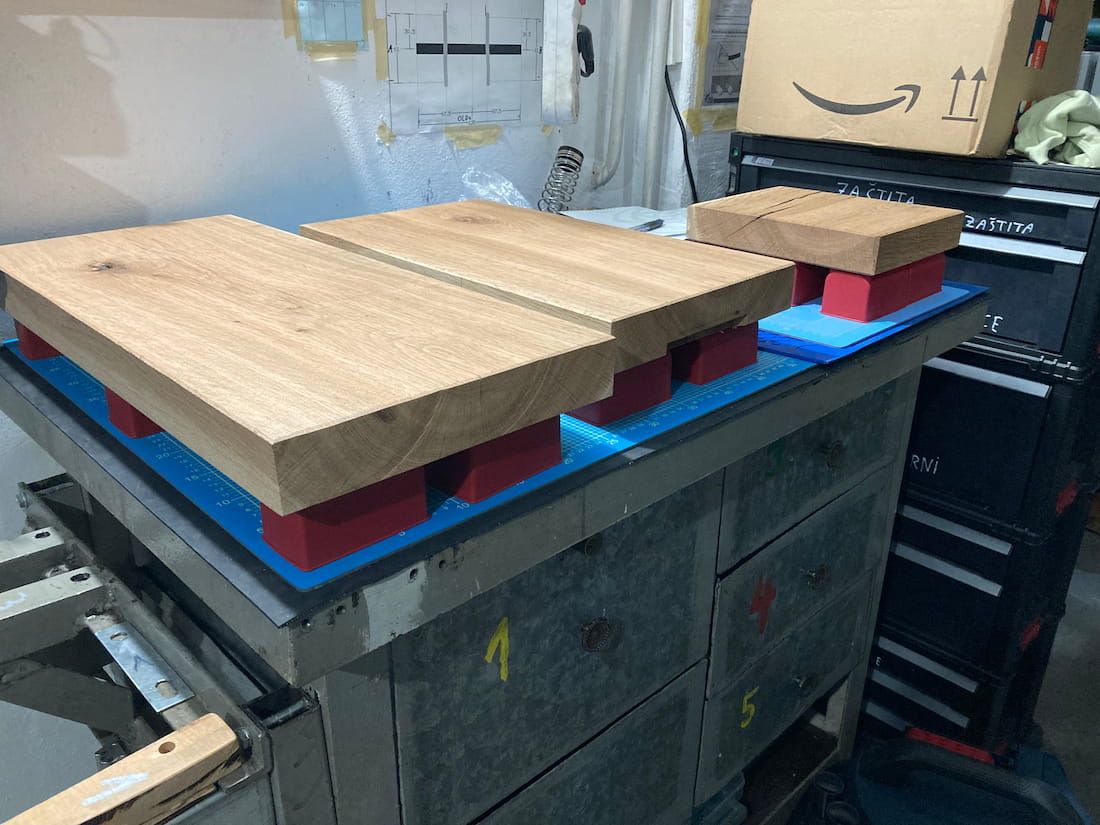
This is my first (and only – for now 🙂 ) article about woodworking. As with most other articles: my goal is to share the knowledge and experience I have, and learn more myself via reader feedback.
1. Introduction: why wood?
Most of my work revolves around metal – fixing things, mechanical repairs, drilling, cutting, grinding. But from time to time, I build or adjust things out of wood. It might be a shelf, a custom tweak for some furniture, or a structural repair around the house.
There’s something deeply satisfying about woodworking. It’s warmer. More natural. Meditative, even. Unlike metal, which often feels cold and final, wood feels alive – because it still is, in many ways.
1.1. Wood is the optimal material
It’s cool being able to fix things around the house: repair furniture, modify it for specific needs, or build something from scratch. And for a lot of those jobs, wood is the *optimal material.
* Optimal is like “the best,” but when you account for all the costs, pros and cons of every available option. 🙂
How so?
- It feels warm and pleasant to the touch – unlike cold metal or lifeless plastic.
- It’s strong enough for many everyday uses, but still relatively lightweight.
- And very importantly: it’s easy to work with. You can cut, drill, glue, or sand it without needing heavy-duty tools (compared to most metals).
For practical, everyday DIY – wood often hits the sweet spot.
2. Wood moves – always
Wood is never truly still. It contains moisture, and as the temperature and humidity change, so does the wood.
Even wood that’s been stored outside to dry and set for a year – shielded from direct rain – will likely warp when brought inside. Let it settle in its final environment before doing precise cuts.
3. Understanding the grain: think of straws
Wood is not uniform like metal. It’s made of fibres – long strands running the length of the tree.
A digression for the cycling crowd: see my section about composite materials for some nuances on composite materials when it comes to carbon fibre bicycle frames and parts – and note that wood is like the natural, “before-it-was-cool” composite material – as I’ll explain below. 🙂
A helpful analogy: think of a bundle of drinking straws. That’s how wood grain behaves.
- Along the grain: stronger, smoother, less absorption.
- Across the grain (end grain): more fragile, soaks up finishes like a sponge.
It’s not a uniform structure/material, but a joined set of fibers, bound with lignin+hemicellulose making a natural fibre-reinforced matrix structure, with mostly unidirectional fibres (for those into cycling or composite materials, the above-noted analogy should make more sense now).
This affects everything – cutting, gluing, painting, even sanding, and – also very important – load bearing.
3.1. Cutting, planing and sanding
Cutting, planing, and sanding all behave very differently depending on grain direction:
- Along the grain
This is generally smoother. When planing or sanding with the grain, you reduce the chance of tear-out and get a cleaner surface. It’s also easier on your tools. - Against or across the grain
Tools are more likely to catch or tear fibres. Planing across the grain (perpendicularly) or worse, against it (pushing into splinters), can lead to rough surfaces, splinters, or even chipping. Sanding against the grain leaves visible scratches that are hard to hide with finish.
Bottom line: go with the grain whenever possible, especially in finishing passes.
Note: when cutting along the grain, use sharp tools and don’t force, so you avoid grains leading your cut a bit astray from what you’ve planned.
3.2. Applying finishes or glue
This applies to every stage – from joint strength to final aesthetics:
- Across the grain
Higher absorption – great for glue joints, but also for sucking in (too?) much paint. - Along the grain
Lower absorption – finishes may wick off or shear more easily.
4. Filling cracks and imperfections: structural or cosmetic?
- For strong gap filling (and larger gaps)
Mix fine sawdust with wood glue – it sets hard and can be sanded flush. - For looks only
Use wax sticks (colour-coded to match your material) to melt over cracks or knots – just know they don’t add any strength.
5. Protecting the surface
There are two main types of protective finishes:
5.1. Penetrating or “re-coatable” finishes
Examples: boiled linseed oil, Sadolin (and similar products).
* Sadolin is a commonly used brand of penetrating wood stain in Europe (and Serbia).
- Pros
Easy to maintain – clean, lightly sand, and reapply yearly. - Cons
Needs regular reapplication and doesn’t protect as well from moisture.
5.2. Sealing finishes (hard coats)
Examples: Varnish, polyurethane (water and oil based protective paints).
- Pros
Tougher, better water resistance. - Cons
When it wears down, you must strip it fully before reapplying – often tedious and time consuming.
Choose based on your needs and tolerance for maintenance vs. maximum protection.
6. Finishing thoughts (pun intended)
As with bikes or metal, understanding the material makes everything easier (and less likely to explode in your face).
Questions, corrections, better ideas? Drop a comment. I’m always happy to learn more (and argue, politely – LOL 🙂 ).
And stay tuned for:
“Woodworking 102: shear forces and emotional damage” 🙂
Appendix: VIDEO about woodworking
I’ve also made a video where I show some of the things that I wrote about here:
https://www.bikegremlin.com/3457/woodworking-101-for-tinkerers-not-purists/
Last updated:
Originally published:
